Key Highlights
- The single most important number is your sauna’s interior volume in cubic feet — length × width × height.
- A good starting rule for a well-insulated indoor sauna is roughly 1 kW for every 45–50 cubic feet.
- Glass walls, high ceilings, outdoor placement and bare-log walls all mean you should size up.
- When you’re between two sizes, always round up — a slightly larger heater reaches temperature faster and runs less strained.
- Electric HUUM heaters also need a UKU control unit and sauna stones; wood-burning stoves need a chimney/flue kit and stones (sold separately).
Introduction
Choosing a sauna heater comes down to one question more than any other: is it powerful enough to bring your room up to temperature — and no more powerful than it needs to be? Get the sizing right and your sauna heats evenly, holds a soft, steady heat, and doesn’t waste energy. Get it wrong and you either wait forever for a lukewarm room, or you overpower a small cabin and scorch the air before the stones are properly saturated.
The good news: sizing a sauna heater is simple arithmetic once you know your room’s volume. This guide gives you the rule of thumb, a sizing chart by cubic feet for both electric and wood-burning heaters, the five factors that change the answer, and the exact HUUM models that fit each size range.
Why trust this guide: Eco Hearth designs and builds custom saunas and is an authorized HUUM dealer shipping across the US. We match heaters to real customer builds — factoring in the exact wall construction, glass and climate, not just floor area. Have a question about your room? Explore our HUUM heaters or reach out to our team.
The quick rule of thumb (volume → kW)
Start by measuring the inside of your sauna in feet — length, width and ceiling height — and multiply them together to get the interior volume in cubic feet (ft³). For a standard, well-insulated indoor sauna, plan on about 1 kW of heater output for every 45–50 cubic feet of that volume.
So a compact 2–3 person room of roughly 250 ft³ lands around 6 kW; a family-sized 5–6 person room near 500 ft³ needs about 10.5 kW. That’s your baseline — the factors further down tell you when to nudge it up.
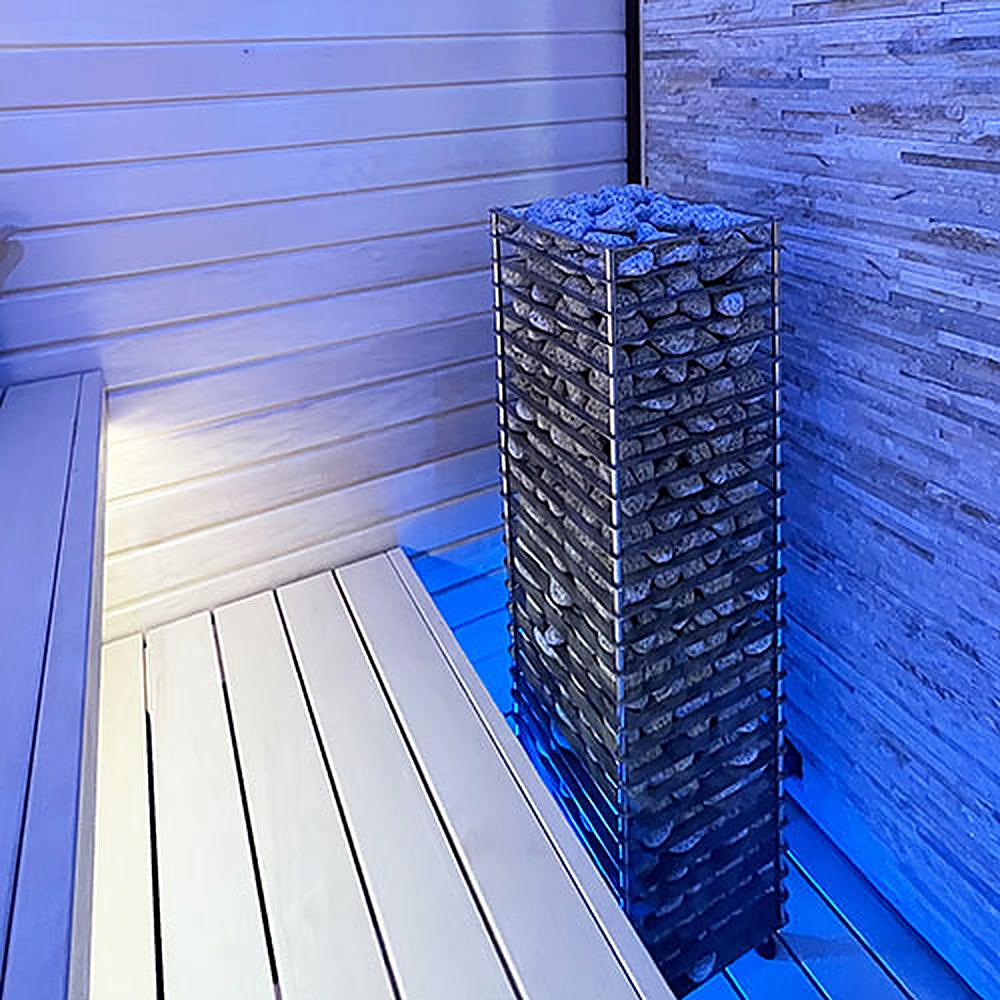
A slim electric heater like the HUUM CLIFF fits tight rooms while still driving enough power for a full family sauna.
Electric sauna heater sizing chart
Find your sauna’s interior volume in the left column and read across. The kW ratings and room ranges below are the manufacturer’s rated ranges for HUUM electric heaters.
| Sauna interior volume | Recommended power | 240V amps* | HUUM models |
|---|---|---|---|
| 106–177 ft³ (small, 1–2 person) | 4 kW | ~15 A | CLIFF Mini 4 kW |
| 177–318 ft³ (2–3 person) | 6–6.5 kW | ~25 A | CLIFF 6, DROP 6, CORE 6.5 |
| 248–389 ft³ (3–4 person) | 7.5 kW | ~31 A | DROP 7.5 |
| 283–460 ft³ (4–5 person) | 9 kW | ~38 A | CLIFF 9, CORE 9 |
| 354–566 ft³ (5–6+ person) | 10.5 kW | ~44 A | CLIFF 10.5, HIVE Mini 10.6, CORE 10.5 |
Browse the full range on the electric sauna heaters page. Most HUUM electric heaters run on 240V single-phase power and pair with a UKU control unit, which is what lets you set temperature, schedule a session, and (on Wi-Fi models) preheat from your phone.
Wood-burning sauna heater sizing chart
Wood-burning stoves are rated in kW too, but their room ranges overlap more than electric models — because you manage output with the fire and air damper rather than a controller. Pick by room size and how you like to fire your sauna.
| Sauna interior volume | Recommended power | HUUM models |
|---|---|---|
| 210–460 ft³ (small–medium) | 8.5–13 kW | HIVE Flow Mini 8.5, HIVE Wood 13 |
| 280–635 ft³ (medium–large) | 9.8–17 kW | HIVE Flow 9.8, HIVE Wood 17 |
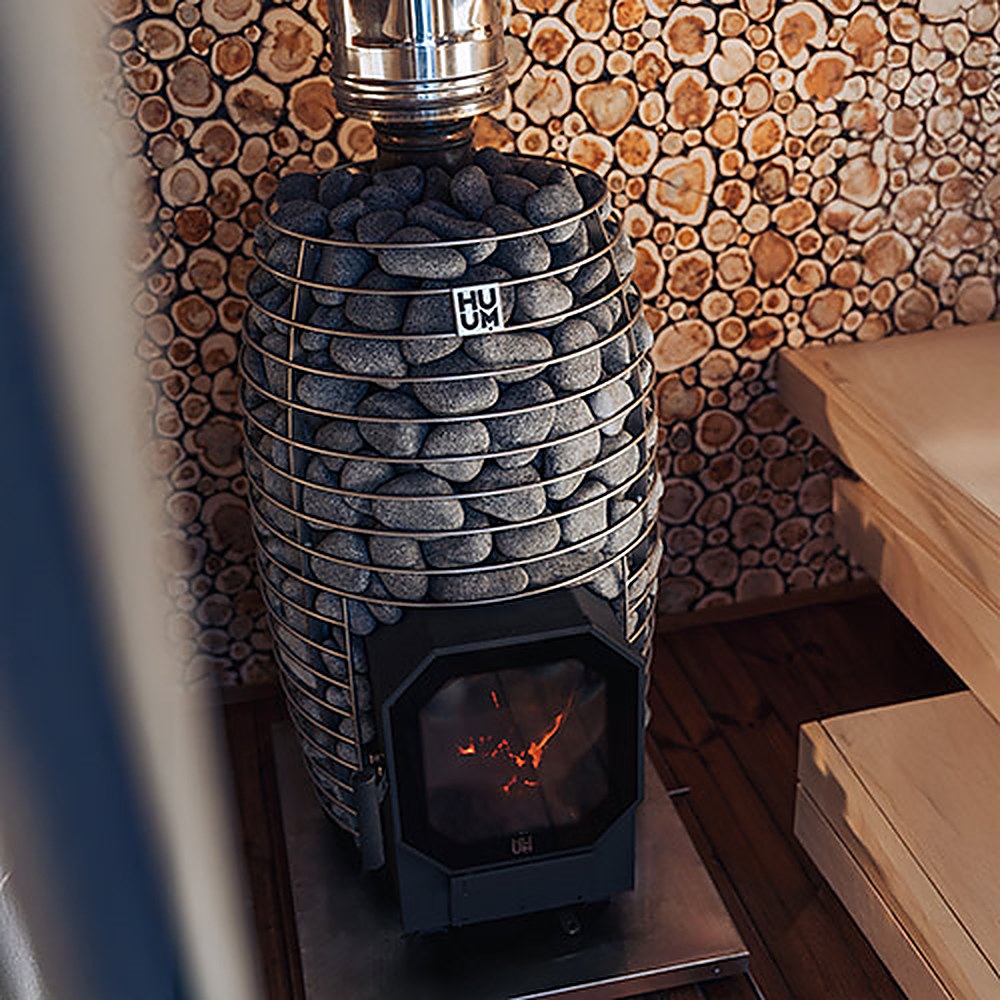
The HUUM HIVE Flow directs about 75% of the fire’s heat into the room — efficient wood-burning for cabins off the grid.
See all models on the wood-burning sauna heaters page. Every wood stove needs a compatible chimney/flue kit, correct wall clearances, and sauna stones — plan those in before you buy.
5 factors that change the kW you need
The charts above assume a modern, insulated indoor sauna with a standard ceiling. Adjust up for any of these:
- Glass doors and windows. Glass loses heat faster than an insulated wall. A large glass front or panoramic window means you should treat the room as larger than its raw volume and step up a size.
- High ceilings. Anything above about 7 ft (2.1 m) adds volume quickly — and heat rises, so a tall room asks more of the heater. Always use your actual measured height, not a standard assumption.
- Outdoor saunas and cold climates. An outdoor cabin — or any sauna facing a cold northern winter — sheds heat through its shell faster than an indoor room. Size up.
- Uninsulated or bare-log walls. Solid-log or poorly insulated rooms need noticeably more power than a modern insulated cabin of the same size.
- When in doubt, round up. Between two sizes? Choose the larger heater. It reaches temperature faster, holds heat more comfortably, and runs less strained than an undersized unit fighting to keep up.
From our own builds: Eco Hearth saunas use a fully insulated, multi-layer wall, so we size toward the lower end of each kW range. If your cabin has bare-log walls or a large glass front, step up a size — those lose heat far faster than an insulated build.
Electric vs wood-burning — does sizing work differently?
Electric sizing is precise: the kW rating maps directly to a room range, and a UKU controller holds your set temperature automatically. It’s the easy choice for most indoor and grid-connected saunas — no chimney, no tending a fire.
Wood-burning gives you the classic crackle and steam, and works anywhere — no electrical supply required. Sizing is more forgiving because you control the burn, but you’ll need a flue, proper clearances, and a spot for firewood. If you’re deciding between the two, room size rarely settles it — access to power, the experience you want, and installation constraints do. Both types scale to a full family sauna: electric up to 10.5 kW / ~566 ft³, wood up to 17 kW / ~565 ft³.
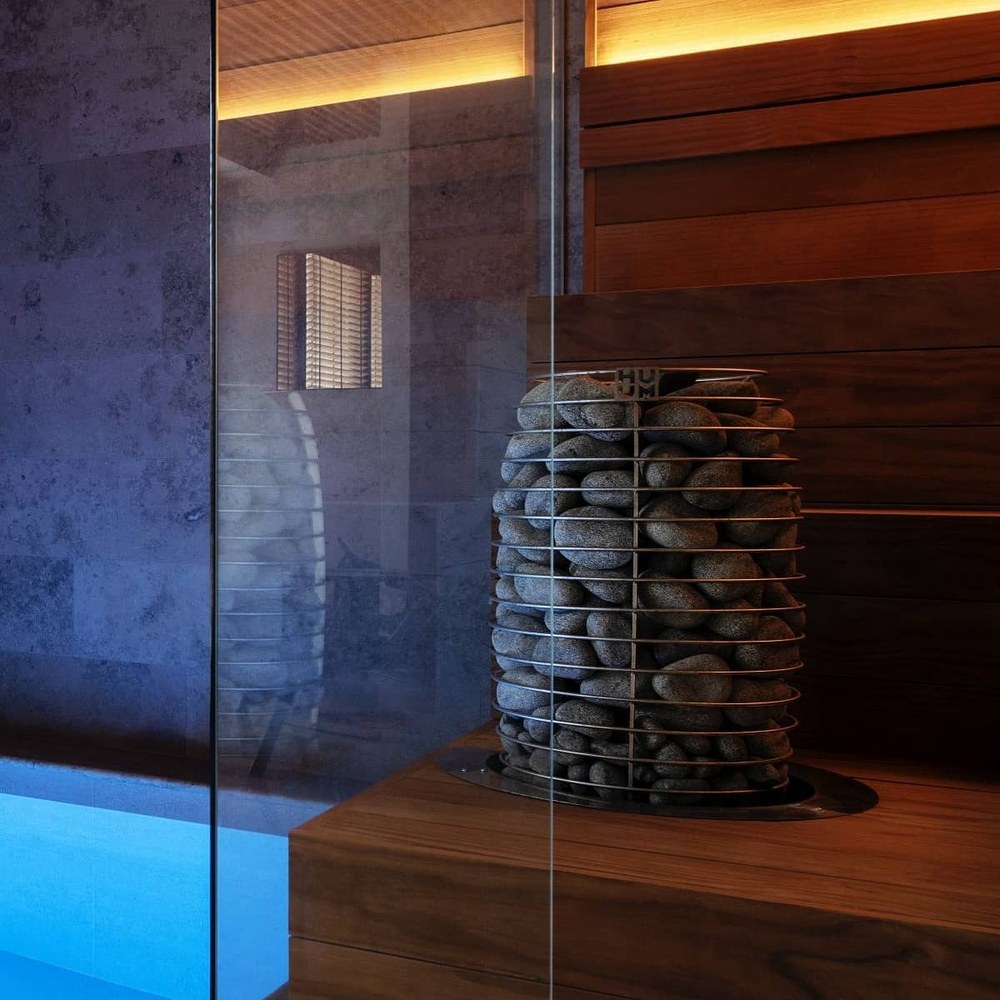
Match your sauna size to a HUUM heater
- Small room, 1–2 person (~106–177 ft³): CLIFF Mini 4 kW — wall-mounted, tiny footprint.
- Compact, 2–3 person (~177–318 ft³): CLIFF 6 kW or the award-winning DROP 6 kW.
- Mid-size, 3–4 person (~248–389 ft³): DROP 7.5 kW.
- Large, 4–5 person (~283–460 ft³): CLIFF 9 kW.
- Family-sized, 5–6+ person (~354–566 ft³): CLIFF 10.5 kW or the floor-standing HIVE Mini 10.6 kW.
- Wood-burning, small–medium rooms: HIVE Flow Mini 8.5 kW or HIVE Wood 13 kW.
- Wood-burning, medium–large rooms: HIVE Flow 9.8 kW, or HIVE Wood 17 kW for the largest cabins.
Design-led build? The CORE line comes in several power ratings and finishes (black metal, or clad in alder, aspen and thermo-aspen) so the heater matches your interior.
Frequently asked questions
What size sauna heater do I need for a 4-person sauna?
A typical insulated 4-person sauna runs about 200–350 ft³, which points to a 6–7.5 kW electric heater. Measure your actual interior volume and adjust up for glass, a high ceiling, or an outdoor build.
Can a sauna heater be too big?
Yes. An oversized heater can overheat the air before the stones are fully saturated, giving you harsh, dry heat and less steam — and it wastes energy. Matching the heater to your room’s volume gives the best, softest heat.
How do I calculate my sauna’s cubic footage?
Multiply the interior length × width × ceiling height, all in feet. A 6 × 5 × 7 ft room is 210 ft³. Then apply the adjustments above for glass, height, insulation and climate.
Do I need anything besides the heater?
Yes. HUUM electric heaters require a UKU control unit and sauna stones (sold separately); wood-burning stoves need a chimney/flue kit and stones. Each product page lists exactly what’s needed for that model.
This guide gives general sizing rules. Always confirm the manufacturer’s rated room range on the specific product page, and consult a licensed electrician (electric) or a certified installer (wood-burning) for your build.
Ready to choose? Compare every model on the sauna heaters page, or explore the full HUUM collection of Estonian-crafted electric and wood-burning heaters.